#127: Why Farm Succession Planning Can’t Wait: Conversations, Control, and the Future of Our Land
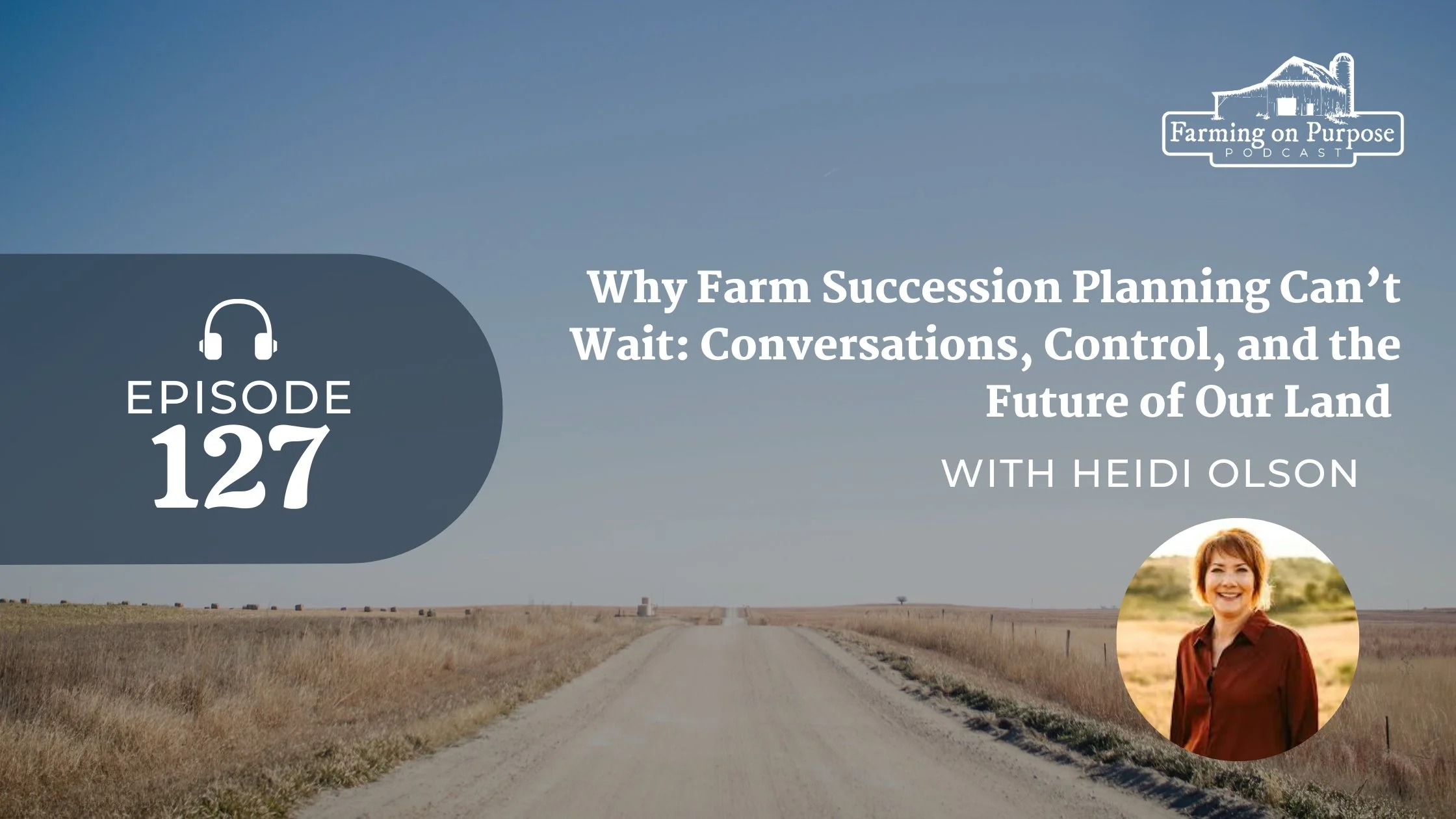
“If you don’t start early enough to make a plan, it never takes care of itself.”
Farm succession planning is one of those topics most producers know they should address—but often put off because it feels heavy, emotional, and overwhelming. I enjoyed sitting down with Heidi Olson for this episode of the Farming on Purpose Podcast to talk honestly about why waiting is risky, how communication breakdowns derail good intentions, and what it actually looks like to start the process in a way that protects both the business and the family.
Heidi is the founder of Pathfinder Legacy Advisor, LLC and a certified farm succession planner based in North Dakota. She brings decades of experience in banking, wealth management, trusts, and estate planning—along with firsthand experience navigating succession planning on both sides of her own family.
In this conversation, we talk about why succession planning is about much more than legal documents, how to run family meetings like a business, and why the future of agriculture depends on starting these conversations sooner rather than later.
Heidi’s Path to Farm Succession Planning
Heidi grew up on her family’s ranch in southwest North Dakota before beginning her career in banking. Over the years, she worked through multiple departments in the financial industry, including wealth management, trust administration, and estate planning—often helping families navigate complex and emotional transitions.
Later, when she married and returned to farming as the fifth generation on her husband’s family farm, she gained firsthand experience with how differently families approach succession.
“My side of the family handled succession one way. My husband’s family handled it very differently,” Heidi shared. “That contrast—and what I saw working with clients—made it clear there was a real need for someone who understands both the financial and operational sides of farming.”
That combination of professional expertise and lived experience ultimately led Heidi to start Pathfinder Legacy Advisor, where she now helps farm families bridge the gap between planning on paper and operating in real life.
Why Waiting Too Long Is So Risky
One of the most striking moments in our conversation was when Heidi shared a statistic that puts urgency behind this issue:
An estimated 350 million acres of U.S. farmland are expected to change hands in the coming years—and much of it is owned by producers age 65 and older.
Without clear plans in place, families risk:
Losing land unintentionally
Creating financial strain for the next generation
Damaging family relationships
Opening the door for corporate ownership when family succession fails
“People keep kicking the can down the road,” Heidi said. “They think it’ll take care of itself. It never does.”
How to Start the Conversation (Without Blowing It Up)
One of Heidi’s most practical pieces of advice is also one of the simplest:
Start with a 30-minute meeting.
Not a three-hour marathon. Not a decision-making session. Just a conversation.
Some of her key recommendations:
Do not meet at the kitchen table. Business discussions don’t belong where holidays happen.
Choose a neutral location—an office, shop, or meeting room.
Set a clear agenda and time limit.
Let every person speak without interruption.
Treat it like a business meeting, not a family debate.
The goal isn’t to solve everything—it’s to understand where each person is coming from and what they want for the future.
Communication Is the Biggest Bottleneck
Throughout the episode, Heidi emphasized that most succession problems aren’t legal—they’re communication-based.
Misunderstandings, assumptions, generational differences, and unspoken expectations often cause far more damage than tax structures or entity types.
“Plans change. Equipment breaks. Priorities shift,” Heidi explained. “If you don’t have a system for communication, people assume things were said that never actually were.”
She encourages families to:
Hold regular check-ins (weekly or monthly)
Document meeting notes
Be clear about who is responsible for what
Give grace when plans need to change
Succession Planning Isn’t Just for Big Operations
Another important point Heidi made is that succession planning applies to every operation—not just large, multi-generation farms.
Whether you:
Farm part-time
Work an off-farm job
Run cattle on 40 acres
Partner with siblings or neighbors
You still need to ask:
How long do I want to do this?
Is this financially sustainable?
What does “success” look like for my family?
What happens if something unexpected occurs?
“Just because you grew up in agriculture doesn’t mean you’re obligated to stay,” Heidi said. “You have to do what makes sense for your mental health, finances, and family.”
What to Look for in a Succession Planner
If families decide to work with an advisor, Heidi stressed the importance of experience beyond mediation alone.
A strong succession planner should:
Understand farm financials and balance sheets
Be fluent in trusts, LLCs, and estate structures
Know how farm operations actually function
Work alongside attorneys, accountants, and advisors
Help families implement—not just sign—documents
“It’s not a one-and-done process,” she said. “Someone needs to help families understand what their plan actually means once the paperwork is finished.”
Connect with Heidi Olson
You can learn more about Heidi and her work here:
Website: https://pathfinderlegacy.com
Email: heidi@pathfinderlegacy.com
Podcast: Pathfinder Legacy Podcast
First Step: 30-minute discovery call available through her website
More from Farming on Purpose
The 8-Hour Marketing Plan is your step-by-step roadmap to a clear, effective strategy—built just for you, in just one day. No more second-guessing or wasted time. Get a plan that fits your business and drives results. Sign up here!
If you are interested in signing up for the Marketing Routine class, do so here!
If you would like to support the podcast or be a part of the conversation join the Farming On Purpose Facebook group and visit the Farming on Purpose merch page.
Check out our favorite software tool for online sales!
Thrivecart is a software tool you can use to design online checkouts with every option you can dream up. You can sell physical and digital products, connect to loads of other softwares you use for your website, accepting payments, email marketing, and more. This is the most powerful tool I use and the lowest cost one. I recommend it for anyone who accepts online payments who wants to increase their revenue or average order value. Learn more about what Theivecart can do for your business here: https://backpocketsocial--checkout.thrivecart.com/thrivecart-standard-account/
I may earn affiliate commissions from links on this page.
Listen wherever you get your podcasts!
About the Host of Farming On Purpose, Lexi Wright:
I’m your host, Lexi Wright. I started the Farming on Purpose Podcast from a passion for sharing the future of production agriculture.
I’m so glad you’re here and I hope you’ll take a moment to join the conversation with me and other listeners on social media.
Connect with me on Instagram, Facebook, and TikTok.
Rate, Review & Follow on Apple Podcasts